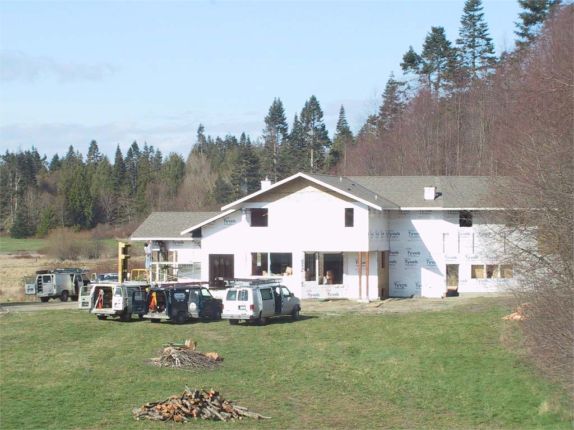
| One morning John looked out the window of our little studio, gasped, and took this picture of all the various subs' trucks. John's comment, "Now the money-meter wheel is really turning fast!"
|
 |
| The windows are delivered and stacked in the garage. After a fair amount of sharpening our budget pencils, we decided to forego wood windows casings. Instead we opted for vinyl windows, but bounced for glass that would block the maximum amount of infrared (heat) energy transfer out. On the south-facing windows we included glass that blocked uv (color-fading) energy transfer in as well.
|
 |
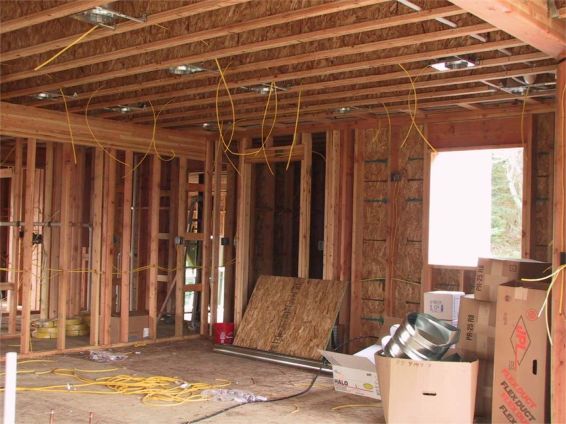
| The kitchen in the midst of electrical and hvac installation.
|
 |
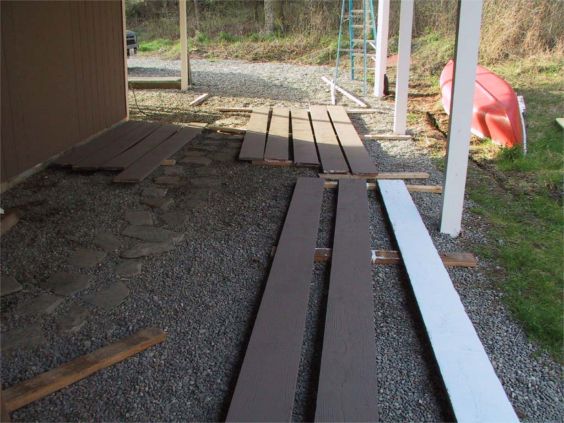
| We hired a mom-and-pop operation to do the painting (Ruth = "mom" and John = "pop"). Mom and pop decided that it would be much easier to paint on the ground before everything got nailed in place on a two-story house. This is the "belly-band" a decorative board that encircles the house at ground level, just below the beginning of the siding. The siding itself will be Hardiplank - a pre-primed fiber-cement product. The belly band boards, however, are cedar so they need both priming (the white) and painting (the brown). The eaves of our barn have become a weather-sheltered painting area.
|
 |
| That's the general contractor on the left and the lead framer on the right. The soffits are up, the windows are going in. What could they be thinking?
|

|
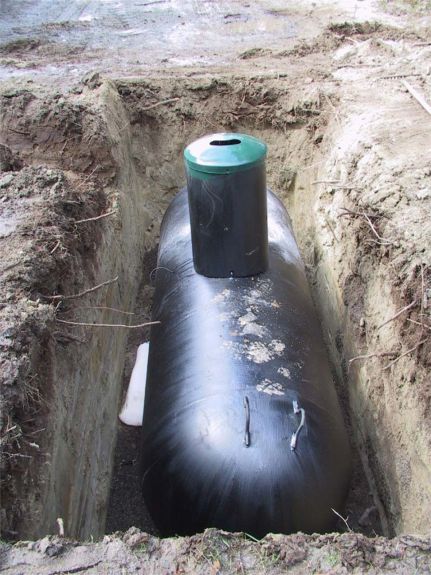
| In our not-so-urban area, each home's "mechanicals" includes all of the services that are usually part of suburban infrastructure. A nuclear submarine? No, we just install our own propane tank in order to be able to cook and heat water with gas. |
|
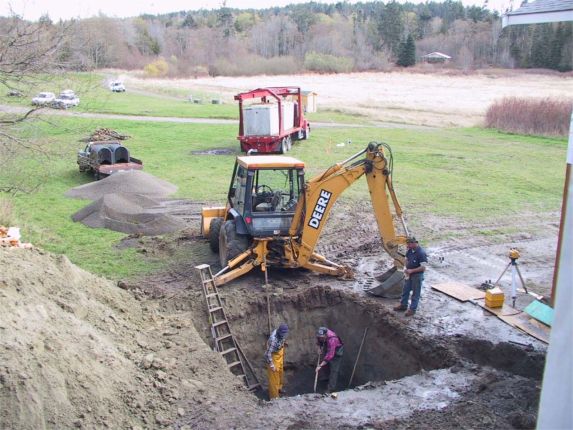
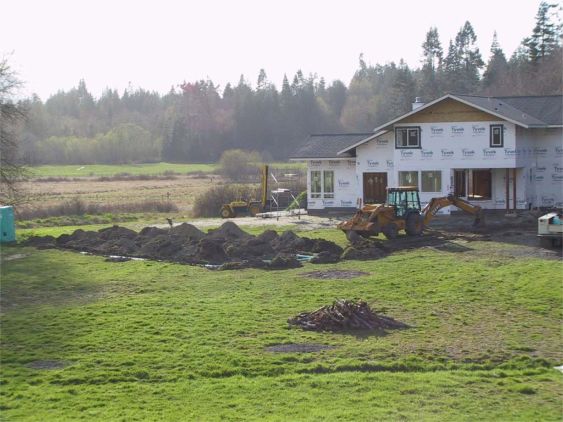
| Here they are digging the vault for the septic tanks. |
|
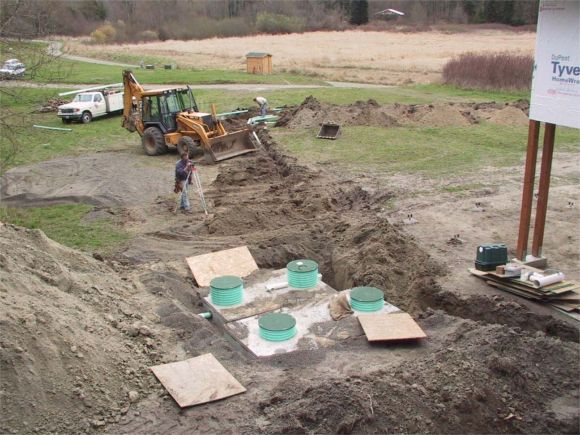
| Yup, not only do we install our own septic system, it's more like a mini-sewage-treatment plant. This is to protect wetland water quality as well as to accomodate for soil that is extremely variable. Two tanks of 1200 and 1000 gals, respectively, are connected in series. |
|
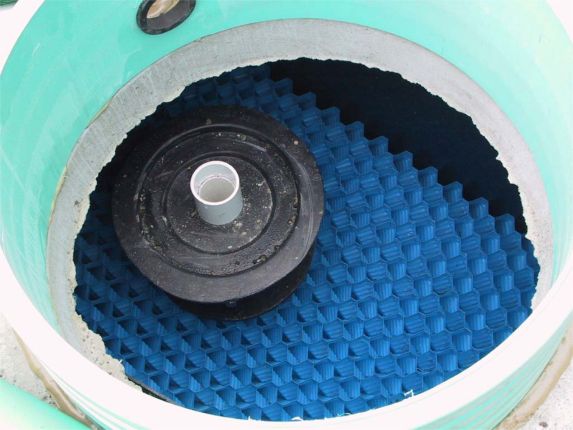
| Each tank has two chambers, for a total of four. Chamber one collects solids. Chamber two consists of an air-pump-driven aerobic digester (seen at right). Chambers three and four trap any debris that makes it through the digester. |
|
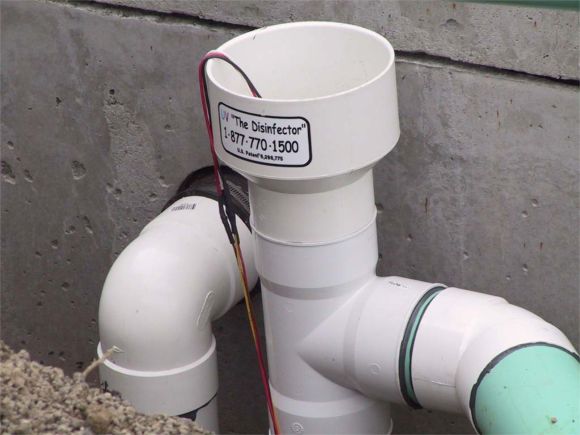
| On it's way "out the door" so to speak, effluent is zapped by a uv light that kills bacteria in the effluent. |
|
| Only then is the by-this-time-quite-clean effluent allowed to migrate through the leach field into the ground. John says that anybody who has to install this sort of system must really be "full of it"! |
|